

Padel vs Pickleball – What Are the Differences?
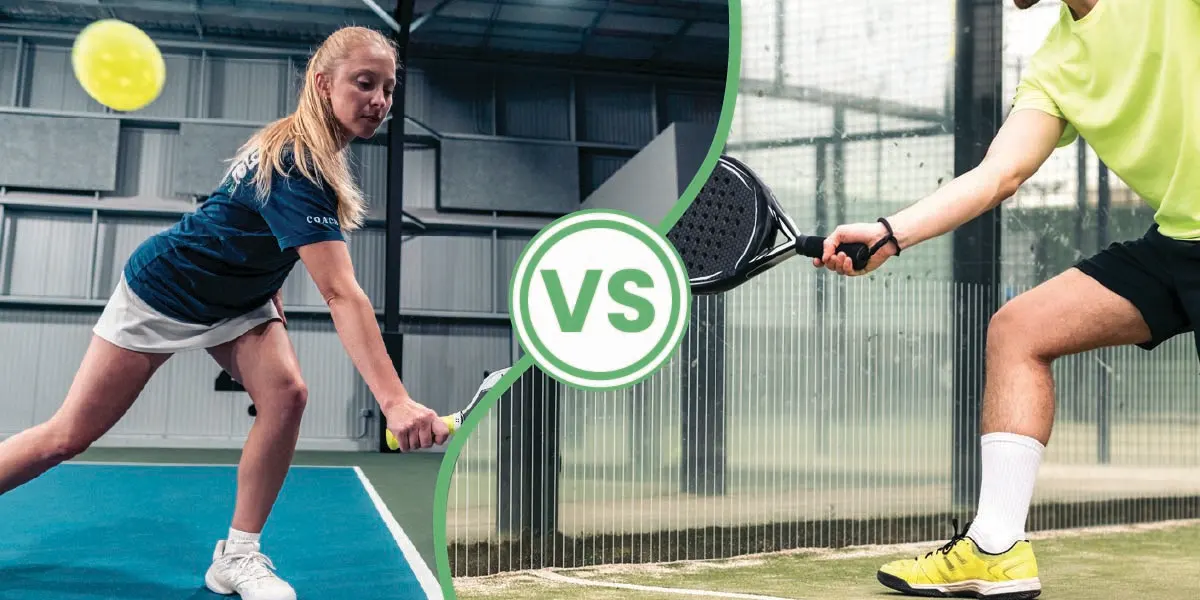
As two of the fastest-growing sports, you may be wondering what the differences are between padel and pickleball. Although they are both racquet sports played on a court where you’re hitting a ball back and forth, the comparisons essentially stop there. They may have these broad similarities, but each of these key aspects are actually what make up some of their main differences.
Padel Rackets vs. Pickleball Paddles
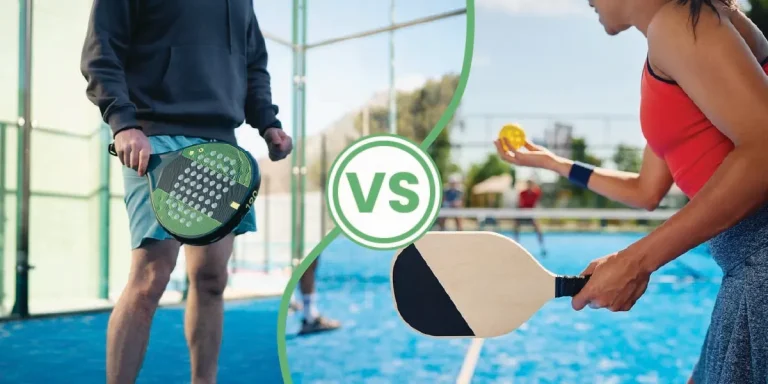
One of the first differences you’ll notice when comparing padel vs. pickleball are the rackets and paddles. Although they are all functionally similar to each other as racket sports, they have some key differences that are apparent once you know what you’re looking for.
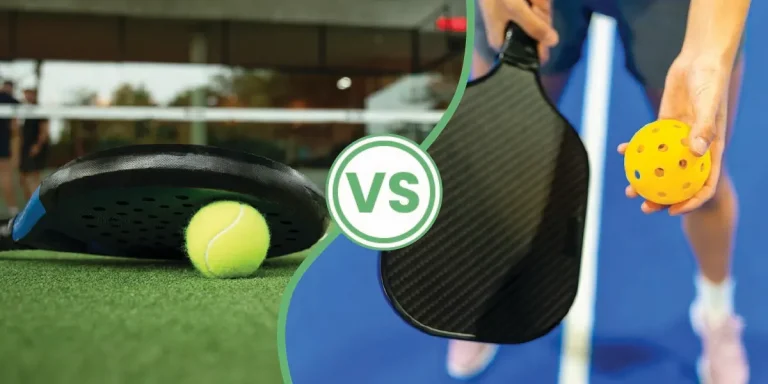
Padel Racket: A padel racket is somewhat similar to ones used for tennis in that it’s a racket meant for hitting a ball. But, compared to a traditional tennis racket, padel rackets are solid without any strings and instead have perforations across their solid hitting surface. They are also much shorter in length. These together create a racket that is similar to other racket sports, but has a specific feeling that is different from tennis rackets.
Pickleball Paddles: Pickleball paddles are quite a bit different in that they are a solid paddle almost similar to something like a ping pong paddle. Similar to larger paddles or rackets, they can be constructed of something as sturdy as carbon fiber or a more basic material like wood. They are also one of the smaller racket sports tools, being even smaller than padel rackets.
Padel and Pickleball Court Differences
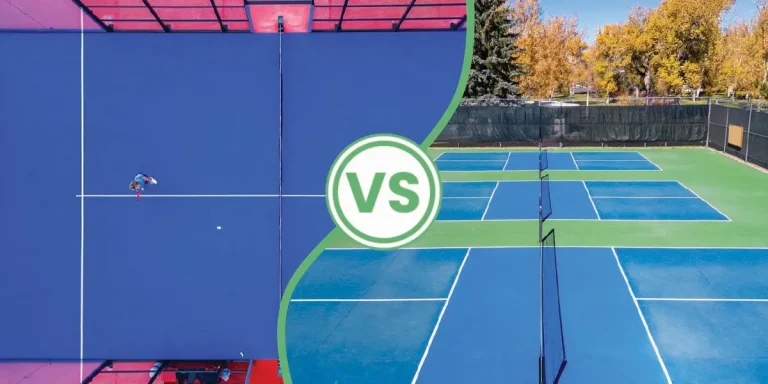
Another major difference that’s immediately apparent when comparing padel and pickleball is the court. From the court size to court design, there are some major differences between the two.
Padel and Pickleball Court Dimensions
The court for paddle is played in a larger court with a 20m x 10m area, whereas pickleball has a smaller court, sitting at 13.41m x 6.09m. Court positioning for players differs slightly because of this, as padel has a tennis-like service box near the net, compared to the no-volley zone (“kitchen”) that pickleball has close to the net.
Padel’s Glass Walls vs. Pickleball’s Open Court
Maybe the biggest difference between the two sports is the enclosed court that padel courts have compared to the open court pickleball uses that is similar to a badminton court. For padel, these walls are part of the game, allowing the ball to rebound during rallies to keep play fast and ongoing. For pickleball, there are distinct “out” lines on the court defined by the rules.
Padel Ball Vs. Pickleball Ball
The ball is another example of a key difference between padel and pickleball. Similar to the racket, it is one that is apparent when you see them side by side.
Padel Ball: The ball in padel is almost identical to a typical tennis ball. But there are some key differences that make them not work quite the same. The first is size. A padel ball is just slightly smaller than a tennis ball. The internal pressure is also different between the two. The internal pressure of a padel ball is around 10 to 11 PSI, whereas a tennis ball is closer to 14 PSI. This lower pressure makes it easier to keep pace with the speed of the ball when bouncing off the glass walls of the court, something that would be too fast and difficult with a tennis ball.
Pickleball Ball: Similar to how padel balls are compared to tennis balls, the perforated plastic ball used in pickleball is often compared to a wiffle ball. They are both balls crafted from a hard plastic that has perforations drilled into it, but have some key differences that make them work better for their respective sports. And the ball used in pickleball may vary based on whether you’re playing indoor or outdoor! Indoor pickleball balls are designed with 26 holes and are larger since you don’t have to worry about wind interfering with the trajectory of the ball. When playing outdoors, a slightly smaller ball is used, which has 40 differently-sized holes that help to keep the ball aerodynamic despite any potential wind. However, many indoor pickleball courts are built with outdoor surfaces, so some players prefer using outdoor balls both indoor and outdoor.
By comparison, wiffle balls have one side of solid plastic and an opposite side with 8-10 oval-shaped holes. They are also less durable, made more for fun than long-lasting competitive potential.
Should You Play Padel or Pickleball?
The answer to this question entirely depends on the player! Obviously, we at Friendly Pickle would love to see you stop by for some pickleball games on our championship-sized courts. Compared to padel private clubs that can make it harder to get out and play, Friendly Pickle has a variety of opportunities for members of our community to play with friends, family, and other pickleball enthusiasts. Whether your group has padel players, tennis players, or experienced pickleball players, you can all enjoy some time on the court with Friendly Pickle!